Request a Quotation or Consultation

Select All

No products have been added to the consultation yet.

MORE PRODUCTS

What are you looking for?

Find the services you need by searching for product names, model numbers, or solution details.

test

smart manufacturing

Factories are generating more data than ever. Cameras inspect products at high speed, sensors continuously track machine conditions, automated systems exchange production data, and AI models analyze operations for defects, anomalies, and optimization opportunities.


Sending every piece of factory data to a remote cloud platform is not always practical. Applications such as high-speed visual inspection and robotic control may require millisecond-scale responses, while high-resolution camera streams can place heavy demands on network bandwidth. Equipment monitoring can also benefit from lower-latency local processing.


Industrial edge computing addresses these challenges by moving computing resources closer to machines, sensors, cameras, and production systems. Combined with AI, an industrial edge AI computer can process operational data directly on the factory floor and turn it into actionable information with minimal delay.


This article explores the most common industrial edge computing applications, how Edge AI supports factory automation, what CPU, GPU, and NPU resources different workloads require, and how manufacturers can select the right computing platform for smart production.


What Is Industrial Edge Computing?

Industrial edge computing refers to processing and analyzing data close to where it is generated, such as beside a production machine, within a control cabinet, or near cameras and sensors on the factory floor.


Instead of continuously transmitting raw data to a centralized cloud or remote data center, an edge system can filter, analyze, and respond to information locally. Relevant results can then be forwarded to higher-level systems such as SCADA, MES, ERP, cloud analytics, or centralized data platforms.


For example, a camera inspecting components on a high-speed production line can send images directly to an industrial edge AI computer. The system can run an AI inference model locally, identify a defect, and trigger a response without first sending the image to the cloud.


This architecture is particularly valuable when an application requires:

•Low-latency decision-making

•Large volumes of sensor or image data

•Continuous operation

•Greater control over operational data

•Reliable processing when cloud connectivity is limited


Smart manufacturing architectures can combine industrial IoT, AI, automation, and edge computing to make production systems more responsive and data-driven. A 2026 roadmap from the National Institute of Standards and Technology (NIST) for AI and machine learning in smart manufacturing highlights advanced sensing, industrial big-data analytics, robotics, autonomous systems, and sustainable manufacturing as important areas where AI is advancing smart manufacturing.


Industrial edge computing does not necessarily replace cloud computing. In many factories, the two work together: the edge handles immediate operational decisions, while cloud or data-center infrastructure supports longer-term storage, fleet-wide analytics, model training, and enterprise-level management.


What Are Common Industrial Edge Computing Applications?

Industrial edge systems can support a wide range of factory applications, from machine-level monitoring to AI-driven inspection and autonomous production.


AI-Powered Machine Vision, Visual Inspection, and Quality Control

Machine vision is a widely used Edge AI application in manufacturing.


Cameras capture products or components as they move through production. An edge computing system then analyzes those images to identify defects such as incorrect assembly, dimensional abnormalities, surface damage, missing components, or packaging errors.


Traditional rule-based inspection remains useful for predictable defects, but AI vision models can help address more variable inspection tasks where defect patterns are difficult to define through fixed rules alone.


Processing images at the edge offers an important advantage: large image or video streams do not need to travel continuously to a remote server before a decision can be made. The system can evaluate each item close to the production line and immediately trigger rejection, alerts, or further inspection.


Avalue currently identifies automated visual inspection, defect detection, anomaly detection, and real-time quality control among its industrial Edge AI use cases.


Predictive Maintenance and Equipment Condition Monitoring

Sensors installed on motors, pumps, bearings, machine tools, and other equipment can continuously collect vibration, temperature, current, pressure, and operating data.


Industrial edge computers can process these signals locally to identify unusual patterns or changes in equipment condition. Instead of relying entirely on fixed maintenance intervals, manufacturers can use this information to investigate equipment before an unexpected failure occurs.


Edge AI can further support anomaly detection by learning normal operating patterns and identifying deviations that may indicate developing mechanical or process problems.


Avalue's manufacturing portfolio includes condition monitoring and predictive maintenance solutions using equipment data such as vibration signals to support equipment diagnosis and maintenance planning.


Production Line Monitoring and Process Optimization

An edge computer can collect information from PLCs, sensors, controllers, inspection systems, and other production equipment to provide a real-time view of manufacturing conditions.


This data may help manufacturers monitor cycle times, production counts, equipment utilization, process parameters, reject rates, and other operational indicators.


Local analytics can also identify patterns that suggest process drift or inefficient operation. Relevant information can then be displayed through an HMI or sent to supervisory and enterprise systems for broader production analysis.


Robotics and Autonomous Production Systems

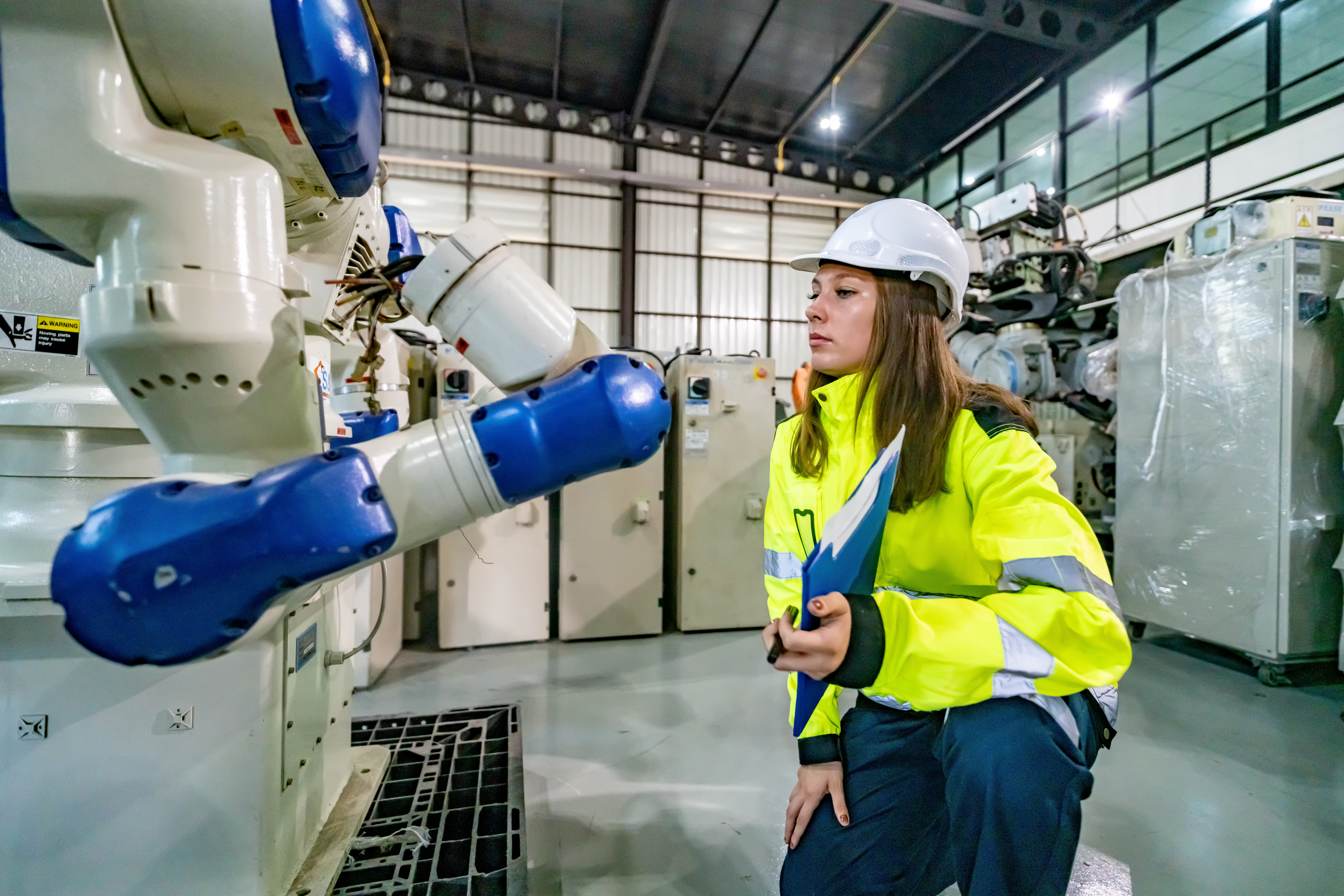
Industrial robots, collaborative robots, automated guided vehicles, and autonomous mobile robots increasingly depend on real-time sensing and computation.


Edge computing can support functions such as object detection, localization, navigation, safety monitoring, and machine vision without requiring every decision to travel through a remote cloud service.


Keeping time-sensitive processing close to the equipment can also reduce dependence on network round trips. NIST identifies low latency, high reliability, mobility, and edge computing as important considerations for wireless communication systems in factory automation environments.


Industrial HMI and Edge Visualization

Industrial panel PCs and HMIs provide operators with direct access to production information, machine status, alarms, dashboards, and control functions.


As more analytics move to the edge, the HMI can evolve beyond simple machine control. A modern industrial panel PC may combine visualization with local data acquisition, analytics, AI inference, and communication with sensors or controllers.


This reduces the number of separate computing devices required at the machine level while giving operators more immediate access to actionable information.


Energy Monitoring and Smart Factory Management

Factories can also use industrial edge computing to collect power, equipment, and process data for energy management.


Instead of reviewing energy consumption only at the facility level, connected sensors and edge systems can help manufacturers monitor individual processes or machines in greater detail and correlate energy use with production conditions.


The U.S. Department of Energy notes that smart manufacturing technologies can combine sensors, data analytics, and process controls to provide real-time visibility into energy, productivity, and costs across manufacturing operations.

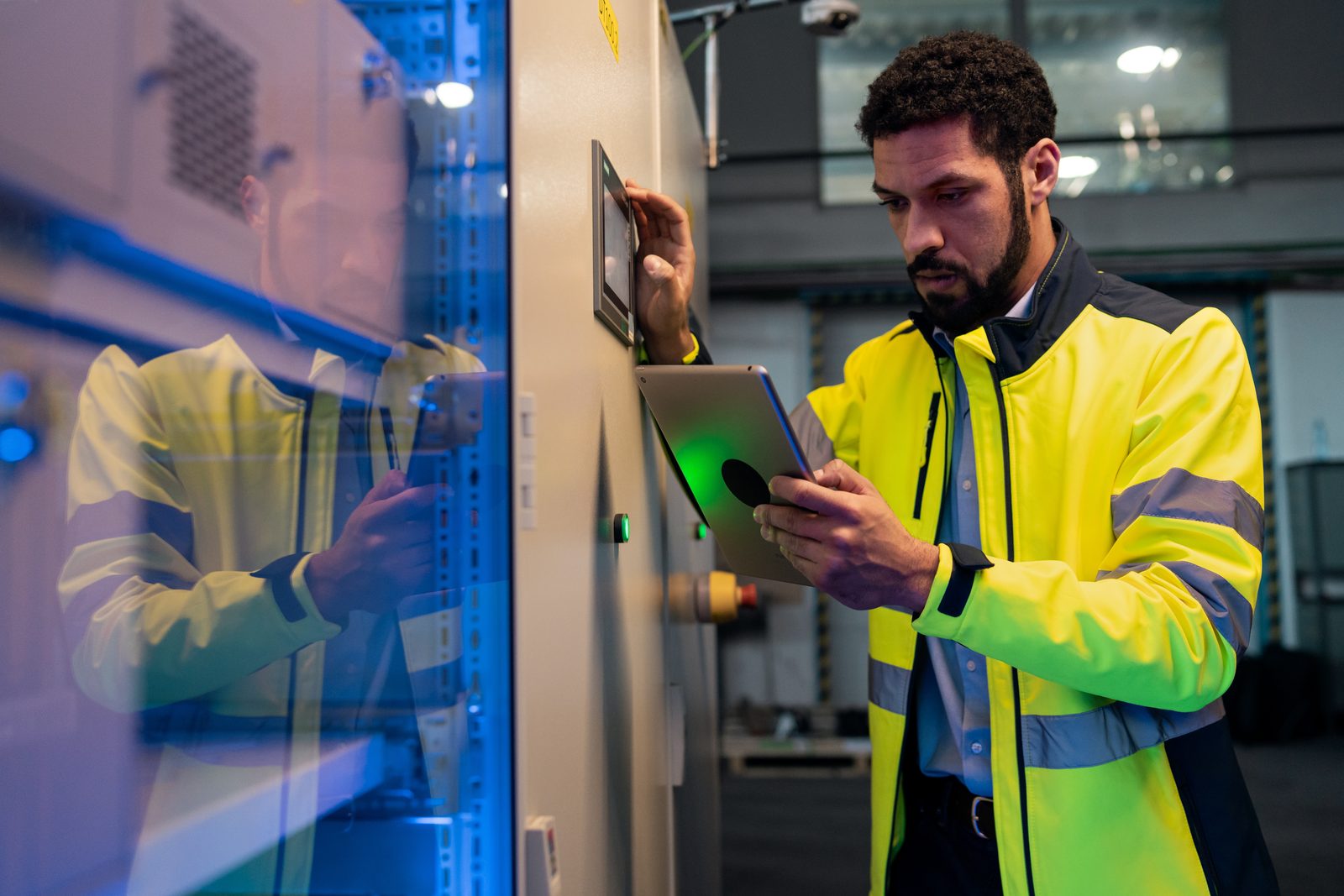
How Does Edge AI Improve Factory Automation?

Edge computing becomes particularly powerful when combined with artificial intelligence.


Traditional automation is often based on predetermined logic: if a sensor reaches a defined threshold, the control system performs a predefined action. Edge AI adds the ability to analyze more complex patterns in images, signals, and operational data.


Real-Time AI Inference Near Industrial Equipment

An industrial edge AI computer can run a trained AI model directly beside the production equipment.


For machine vision, this means camera images can be processed locally. For predictive maintenance, vibration or sensor data can be analyzed as it is generated. For autonomous systems, visual and positioning information can be interpreted close to the machine.


This local inference can reduce the time between data capture, analysis, and response.


Processing High-Volume Sensor and Vision Data Locally

Machine vision applications can generate large amounts of data, particularly when multiple high-resolution cameras operate simultaneously.


Uploading every raw image or video stream to the cloud can consume significant bandwidth. An edge AI system can instead process data locally and transmit only relevant information, such as defect images, alerts, production statistics, or summarized results.


The same principle applies to industrial sensors. Rather than sending every raw measurement upstream, the edge system can aggregate, filter, or analyze the information first.


Supporting Operational Continuity

Industrial production cannot always depend on uninterrupted external connectivity.


If AI inference is performed locally, many machine-level functions can continue even if access to the cloud or central data center becomes temporarily unavailable.


The edge system can continue processing production data and synchronize relevant records once connectivity is restored, depending on the application architecture.


Integrating AI with Existing Factory Automation

Edge AI does not necessarily require replacing existing PLCs, machines, or control infrastructure.


Industrial edge systems can serve as an additional computing layer, receiving data through interfaces such as Ethernet, serial communication, digital I/O, CAN, industrial protocols, cameras, and sensors.


This allows manufacturers to introduce capabilities such as AI inspection or anomaly detection while retaining much of their existing automation infrastructure.


What Are the Benefits of Industrial Edge Computing in Factory Environments?

Industrial edge computing brings computation closer to production processes, which can provide several operational advantages.


•Lower latency for real-time decisions. Local processing reduces reliance on round trips to remote infrastructure, helping systems respond more quickly to machine events, inspection results, or anomalies.


•Reduced bandwidth requirements. Large camera streams and sensor datasets can be processed locally, allowing only relevant information to be transferred upstream.


•Greater control over operational data. Sensitive production images, process parameters, or proprietary manufacturing information can be processed within the factory rather than continuously transmitted externally.


•Continued operation with limited connectivity. Applications designed for local processing may continue functioning when cloud connectivity is intermittent or unavailable.


•Faster anomaly and defect detection. Edge analytics can evaluate machine and production data as it is generated, allowing abnormalities to be identified closer to the point of operation.


•Scalable deployment. Edge computing can be deployed by machine, production cell, or line, allowing manufacturers to expand gradually rather than redesigning the entire computing architecture at once.


These capabilities also support broader Industry 4.0 strategies, where machines, data, automation, analytics, and enterprise systems increasingly work together. The International Society of Automation identifies edge computing, IIoT, AI, machine learning, cloud computing, digital twins, and IT/OT convergence as important technologies associated with industrial digital transformation and Industry 4.0.


AI Computer Buying Guide: Choosing the Right Processor for Edge AI Inference

test

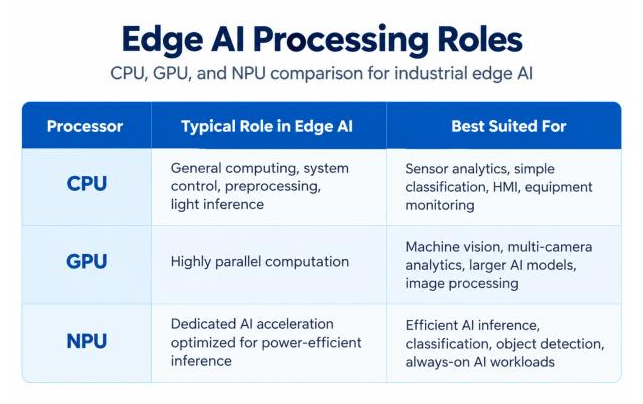
Edge AI Processing Roles: CPU, GPU, and NPU comparison

Selecting an industrial AI computer requires understanding what type of processing the application actually needs. More computing power is not always better if it adds unnecessary cost, power consumption, or heat.


The CPU, GPU, and increasingly the NPU can each perform different roles in an Edge AI system.


•CPU – Typical role: general computing, system control, preprocessing, and light inference. Best suited for: sensor analytics, simple classification, HMI, and equipment monitoring.

•GPU – Typical role: highly parallel computation. Best suited for: machine vision, multi-camera analytics, larger AI models, and image processing.

•NPU – Typical role: dedicated acceleration for AI inference. Best suited for: efficient AI inference, classification, object detection, and always-on AI workloads.


When Is a CPU Sufficient for Edge AI?

CPU-only systems can be suitable when the AI workload is relatively lightweight or inference does not need to process large amounts of data simultaneously.


Examples can include simple anomaly detection, sensor-data classification, basic machine monitoring, or occasional inference tasks.


A CPU-only platform can simplify system design and may reduce hardware cost and system complexity by avoiding a discrete accelerator when the workload does not require one.


When Is GPU Acceleration Needed?

GPU acceleration becomes more important as AI workloads become visually intensive or highly parallel.


Machine vision applications may need to analyze several high-resolution camera feeds, detect multiple object types, perform segmentation, or process images at high frame rates.


In these cases, GPU acceleration can provide substantially more parallel computing capability than relying on a general-purpose CPU alone.


However, GPU selection should be based on the actual workload. Factors such as camera count, image resolution, frames per second, model architecture, precision, and number of simultaneous inference tasks all affect the required performance.


When Is an NPU Suitable for Edge AI?

An NPU, or Neural Processing Unit, is designed to accelerate AI inference with a focus on power-efficient processing compared with general-purpose compute resources.


It is well suited for continuous or always-on tasks such as object detection, image classification, and anomaly detection, especially in compact, fanless, or power-constrained industrial systems.


However, NPU performance depends on software and model compatibility, so developers should confirm support for the required AI framework, model format, and inference tools before selecting a platform.


How Workload Requirements Affect Hardware Selection

A relatively small classification model can have very different hardware requirements from a large object-detection or segmentation model.


Before selecting an industrial AI computer, developers should evaluate:

•Model size and architecture

•Required inference latency

•Number of simultaneous models

•Camera or sensor count

•Input resolution

•Required frame rate

•CPU preprocessing requirements

•GPU or NPU acceleration support


Power and thermal design are equally important. A higher-performance accelerator may increase inference speed but also increase power consumption and heat generation.


For an industrial deployment, the best platform is therefore not necessarily the system with the highest TOPS or GPU specification. It is the one that can deliver the required inference performance reliably within the available power, thermal, environmental, and physical constraints.


What Should You Consider When Choosing an Industrial Edge Computing Solution?

test

Industrial Edge Computing Solution

Factory environments place different demands on computing hardware than offices or data centers. An industrial edge system must provide adequate performance while remaining stable under the conditions where it will actually operate.


AI Performance and Processing Architecture

Start with the workload. Determine whether the application needs CPU processing, integrated graphics, an NPU, a discrete GPU, or a combination of these resources.


For example, sensor monitoring and basic analytics may require relatively modest computing resources, while multi-camera AOI may benefit significantly from GPU acceleration.


Fanless and Rugged System Design

Fans can draw dust and debris into a computer and introduce another mechanical component that may require maintenance. Fanless embedded systems are therefore common in industrial edge deployments.


The enclosure should also reflect the installation environment. Shock, vibration, dust, humidity, and temperature variation may require a rugged computing platform rather than a conventional commercial PC.


Operating Temperature and Environmental Protection

A system installed in a climate-controlled control room faces different conditions from one installed next to production machinery or outdoors.


Review the specified operating-temperature range and any relevant ingress-protection, shock, and vibration ratings.


An IP rating such as IP65 or IP68 should be interpreted carefully: confirm whether it applies to the complete system or only a particular surface or enclosure component. The required protection level should be determined by the real deployment environment rather than selecting the highest rating by default.


Industrial I/O and Expansion

An industrial edge AI computer must communicate with the devices around it.


Depending on the application, this may require:

•Multiple Gigabit or 2.5GbE ports for cameras

•USB interfaces

•COM ports for legacy equipment

•GPIO or CAN bus

•Display outputs

•M.2 expansion

•PCIe slots for GPUs or accelerator cards

•Wi-Fi, cellular, or other wireless connectivity


Future requirements should also be considered. A system that supports one inspection camera today may need to accommodate additional cameras, sensors, or AI accelerators later.


Cybersecurity and System Management

Connecting operational technology to broader networks expands the cybersecurity requirements of industrial computing systems.


Features such as TPM, secure boot, device authentication, operating-system maintenance, access control, and remote device management can help support a more secure deployment.


Manufacturers should evaluate cybersecurity at the complete system level rather than relying on a single hardware feature.


Product Lifecycle and Long-Term Support

Industrial systems are often deployed far longer than consumer computers.


Frequent platform changes can force equipment manufacturers and system integrators to repeat software validation, compatibility testing, and hardware qualification.


A suitable industrial computing supplier should therefore provide clear lifecycle information, controlled revisions, technical support, and advance notification of component or product changes.


What Industrial Edge Computing Solutions Does Avalue Provide for Factory Automation?

Avalue's current industrial computing portfolio spans edge AI systems, fanless embedded computers, industrial panel PCs, industrial and embedded boards, ARM-based platforms, rugged systems, and higher-performance computing platforms. The company positions these products for applications including smart manufacturing, industrial automation, AOI, machine vision, and Edge AI inference.


Edge AI Systems for Real-Time Industrial Inference

Avalue offers edge computing platforms with different levels of AI performance for workloads ranging from lightweight classification and anomaly detection to multi-stream analytics and larger AI models.


Its Edge AI portfolio includes systems designed around heterogeneous CPU, GPU, and NPU processing as well as expandable platforms capable of supporting additional accelerators.


A recent example is the EPC-WCL fanless embedded system, which combines CPU, integrated GPU, and NPU resources and is positioned for applications including smart manufacturing and AOI visual inspection. Avalue specifies up to 40 TOPS of combined AI performance for the platform.


Fanless Embedded Computers and Industrial Panel PCs

For equipment-level and factory-floor deployment, Avalue offers compact fanless systems designed around industrial connectivity and long-term operation.


Its industrial panel PC portfolio extends these capabilities into HMI and operator-facing applications. Current ARC-series systems provide fanless operation, industrial I/O, modular expansion, and rugged features for factory automation and production-line monitoring.


Embedded Boards and Computing Modules

For OEMs building computing directly into industrial equipment, Avalue provides industrial motherboards, single-board computers, and embedded computing platforms in multiple form factors.


These platforms allow equipment manufacturers to select computing performance, I/O, expansion, and form factors according to their own mechanical and system requirements.


Machine Vision, AOI, and Predictive Maintenance

Avalue highlights automated visual inspection and predictive maintenance as core industrial Edge AI use cases.


For visual inspection, edge computing platforms can combine camera inputs with AI inference to perform defect detection close to production equipment. For equipment monitoring, sensor and vibration data can be processed to support anomaly detection and predictive maintenance.


With platforms ranging from compact embedded systems to expandable Edge AI computers and industrial HMIs, manufacturers can select computing resources according to the scale and complexity of each production application.


Planning an Edge AI deployment for machine vision, AOI, predictive maintenance, or factory automation? Contact Avalue to discuss your application requirements and find an industrial edge computing platform that fits your performance, connectivity, and deployment needs.


Industrial Edge Computing FAQs

What are common industrial edge computing applications?

Common applications include AI-powered visual inspection, predictive maintenance, machine condition monitoring, production analytics, industrial HMI, robotics, autonomous systems, and energy monitoring.


These applications benefit from processing data close to production equipment, particularly when low latency, high data volumes, or continuous operation are important.


Why is edge computing important for smart factories?

Edge computing allows factories to analyze operational data close to where it is generated.


This can shorten response times, reduce the amount of raw data transmitted across networks, support continued operation when cloud connectivity is limited, and make it easier to scale analytics or AI applications across individual machines and production lines.


What is the difference between edge computing and edge AI?

Edge computing describes the broader practice of processing data close to its source instead of relying entirely on centralized cloud infrastructure.


Edge AI is a specific use of edge computing in which AI models run locally. For example, an edge computer may simply collect and aggregate machine data, while an Edge AI system could analyze the same data with a trained model to identify anomalies or predict equipment problems.


What industrial edge computing solutions does Avalue provide for factory automation?

Avalue provides fanless embedded systems, Edge AI computers, industrial panel PCs, industrial and embedded motherboards, ARM-based platforms, expandable systems, and rugged industrial computing solutions.


These platforms support applications including industrial automation, HMI, machine vision, AOI, predictive maintenance, real-time production monitoring, and AI inference at the edge.


Avalue Privacy Statement
INTRODUCTION

Welcome to avalue-usa.com ("we," "our," "us"). Your privacy is important to us. This Privacy Policy explains how we collect, use, disclose, and safeguard your information when you visit our website .

Privacy Policy Effective Date: Feb.13th, 2025

PAGE CONTENTS

A.Information We Collect

B.How We Use Your Information

C.Sharing Your Information

D.Cookies and Tracking Technologies

E.Data Security

F.Third-Party Links

G.Your Rights and Choices

H. Changes to This Privacy Policy

I. Contact Us

A. Information We Collect

We may collect the following types of information:
Personal Information: Name, email address, phone number, mailing address, and other contact details provided voluntarily.

Usage Data:
Information about how you interact with our website, such as IP address, browser type, pages visited, and duration of visit.

Cookies and Tracking Technologies:
We may use cookies and similar tracking technologies to enhance user experience and analyze website performance

B. How We Use Your Information

We use the collected information to:
1. Provide, operate, and maintain our website.
2. Improve user experience and website functionality.
3. Communicate with you, including responding to inquiries.
4. Analyze usage trends and monitor website performance.
5. Comply with legal obligations.

C. Sharing Your Information

We do not sell or rent your personal information. However, we may share your information with:
Service Providers: Third-party vendors that help us operate the website.
Legal Requirements: If required by law, we may disclose your information to comply with legal obligations.

D. Cookies and Tracking Technologies

We use cookies to improve website functionality and user experience. You can adjust cookie settings in your browser to disable or limit their use.

E. Data Security

We implement appropriate security measures to protect your personal information from unauthorized access, disclosure, or destruction.

F. Third-Party Links

Our website may contain links to third-party websites. We are not responsible for their privacy practices and encourage you to review their policies.

G. Your Rights and Choices

Depending on your jurisdiction, you may have rights regarding your personal data, such as access, correction, deletion, or opt-out of certain uses. Contact us to exercise these rights.

H. Changes to This Privacy Policy

We may change this Privacy Policy from time to time by posting a new version on this page. The new version will become effective on the date posted, which will be listed at the end of the page as the Last Updated.

I. Contact Us

If you have any questions about this Privacy Policy, please contact us at: support@avalue-usa.com

Subscribe Newsletter

Check the topics you're interested in, and be the first to receive the latest updates on them!

Subscribe Subject

Invalid format

Press Release

E-letter

White Paper

Enter Confirmation Code

Subscribe Successfully

Thank You for Subscribing, We look forward to staying in touch with you!

CLOSE

Unsubscribe

Check the topics you're interested in, and be the first to receive the latest updates on them!

Enter Confirmation Code

Unsubscribed

You have successfully unsubscribed from our emails. We always welcome you to resubscribe at any time.

CLOSE