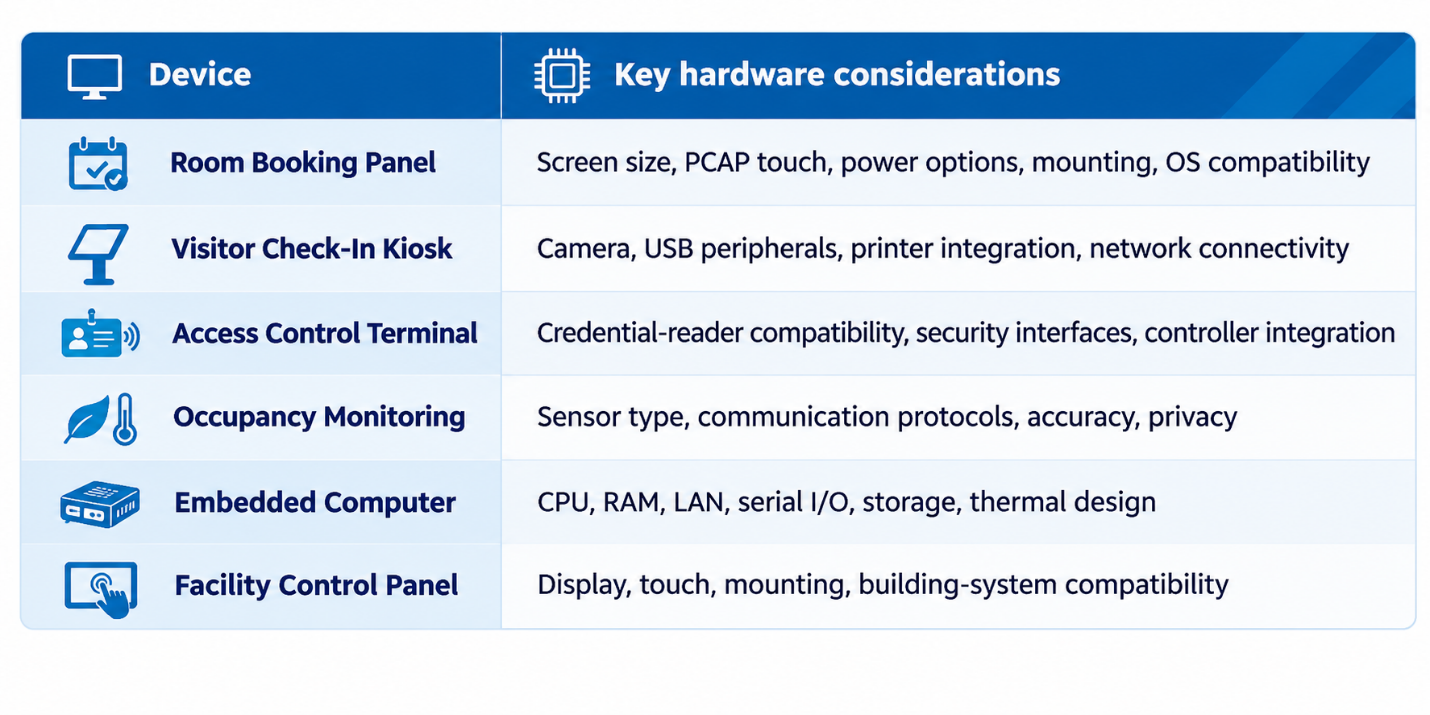
Smart office devices serve different roles: interactive panels present information, sensors capture conditions, building controls carry out approved actions, and local computers connect equipment with software. The most common devices are meeting room booking panels, visitor check-in kiosks, access control terminals, occupancy and environmental sensors, embedded computers, and IoT gateways.
Meeting Room Booking Panels and Scheduling
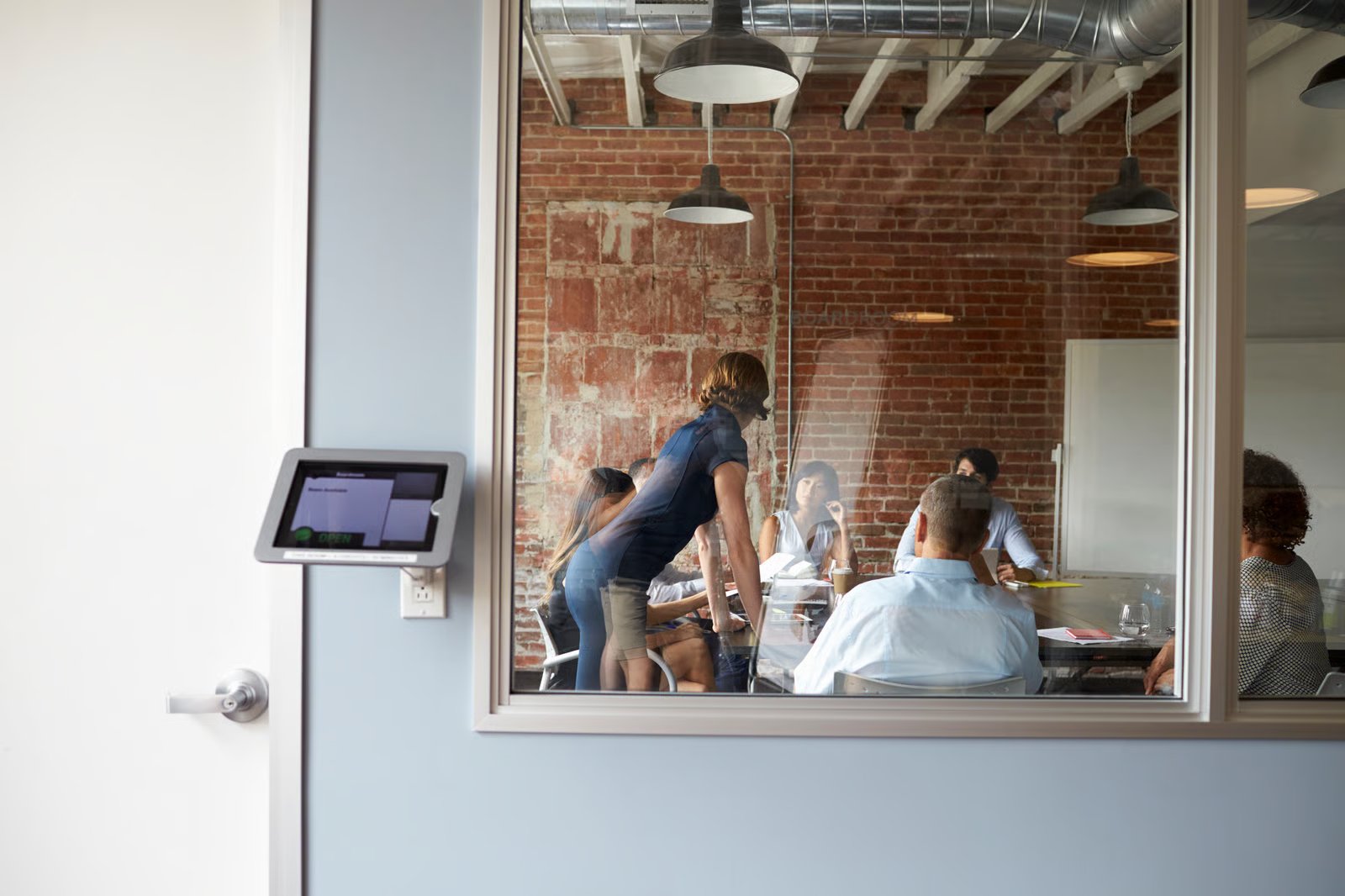
A booking panel outside a meeting room shows current availability, upcoming reservations, and room information supplied by scheduling software. Check-in, on-the-spot booking, and reservation release are application functions, so verify them with the selected platform before specifying hardware.
The scheduling platform remains the system of record, while an industrial panel PC supplies the on-site touchscreen and computing platform. For a configurable room-booking interface, check screen legibility, touch responsiveness, mounting, power, network connectivity, operating-system support, and compatibility with the booking application.
Visitor Check-In Kiosks, Video Intercoms, and Access Control Terminals
A reception kiosk presents appointment lookup and visitor registration through its application. Host notifications need a connection to the notification service, and badge printing needs a compatible printer. For building entry, video intercoms support two-way communication, while access-control readers and controllers manage credential checks and door permissions.
For a visitor kiosk, the panel PC supplies the touchscreen and computing platform. Identity verification and door control require separately specified security software, readers, and controllers. Before choosing hardware, list the camera, audio, printer or scanner, network, and mounting requirements for the workflow.
Occupancy and Environmental Sensors
Occupancy sensors collect presence signals for rooms, desks, and shared areas. Temperature, humidity, carbon dioxide, and light sensors provide readings for facility dashboards. For automated lighting or HVAC, verify that the building controller accepts the sensor input, supports the required communication protocol, and implements the intended control rules.
Basic motion sensors, such as passive infrared (PIR) sensors, detect movement but generally cannot provide reliable people counts. Dedicated people-counting systems may use cameras, radar, or other sensing technologies, depending on accuracy and privacy requirements.
Embedded Computers and IoT Gateways
An IoT gateway exchanges data through its supported device interfaces and protocols. An embedded computer runs local applications, processes selected sensor readings, and communicates with central systems. For a multi-floor office, compare protocol support, connected-device count, workload, and fault recovery before deciding where to place each component.
For each gateway or embedded computer, document the required I/O ports, communication protocols, processing load, and functions that must remain available offline. Test reconnection, data synchronization, and recovery after network or power interruptions.
Building Controls and Facility Panels
A facility control panel presents equipment status and authorized controls, while the building automation controller executes the control logic. In an occupancy-based lighting setup, the sensor reading is only an input to a configured rule. Test timeouts, sensor faults, and manual override behavior before activating automated responses.